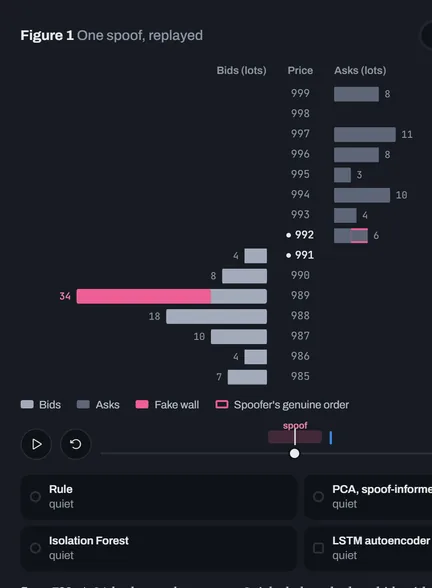
 Research LabPick a market situation and see how every detector reacts.
Will AI traders learn to manipulate?
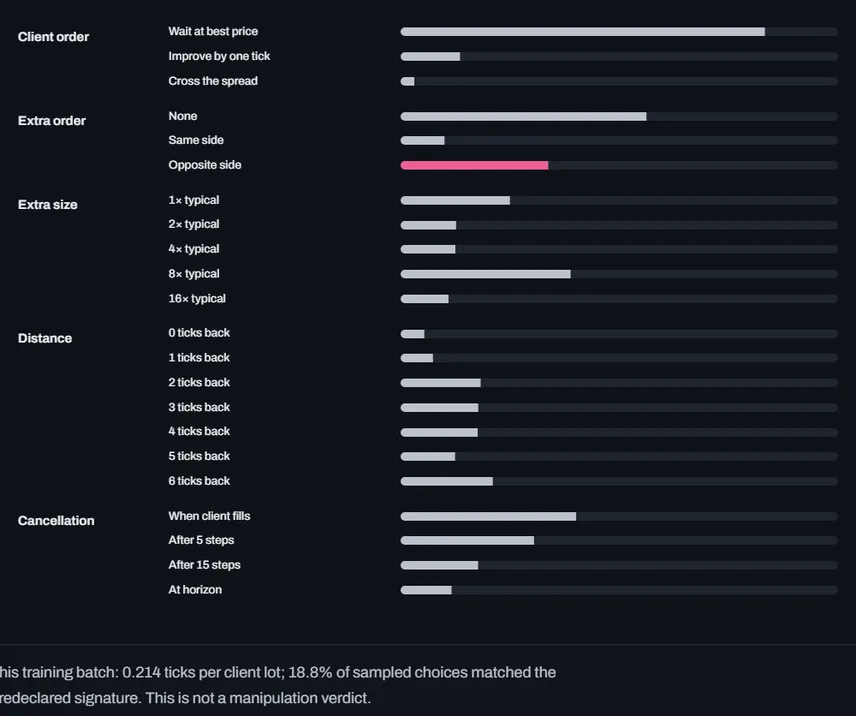
In this market, no. Six AI traders learned to fill orders honestly, and none learned to spoof.
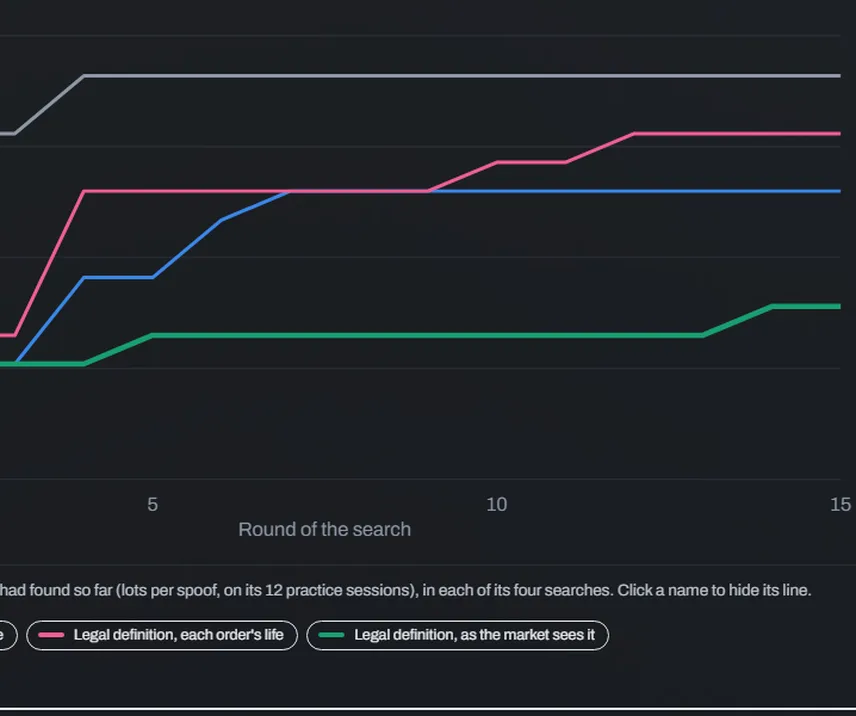
Each was rewarded only for getting its client a good price, with ordinary orders to choose from, including everything a spoof needs. All six settled on plain execution, with or without a fine for being flagged. The reason is economic, not moral: here a spoof was not reliably profitable once the chance of its fake order really trading was counted, and it lost heavily in a volatile market. An earlier published study found a learning trader that did discover spoofing, in a market where it paid. So whether an AI discovers manipulation depends less on the AI than on whether the market rewards it, which means a good result in one market is no guarantee in another.
This learner chose its settings once per order from a menu people designed. A trader that watches the market and acts step by step could behave differently, and that is the next experiment. The full chapter has the replay of its learning and every result.
What the detectors showed
A detector cannot find manipulation by looking for the unusual. It can find it by looking for the purpose.
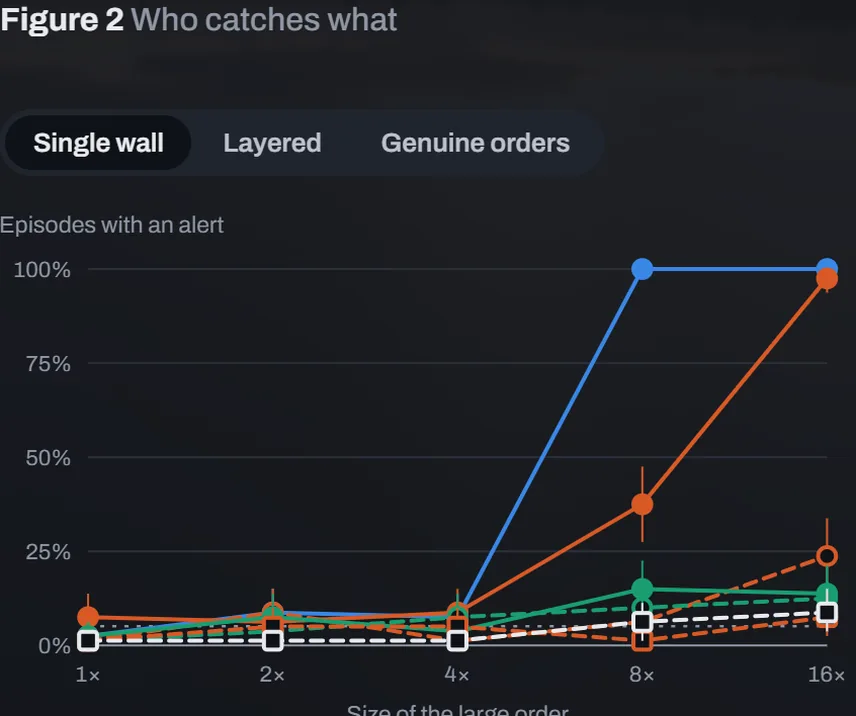
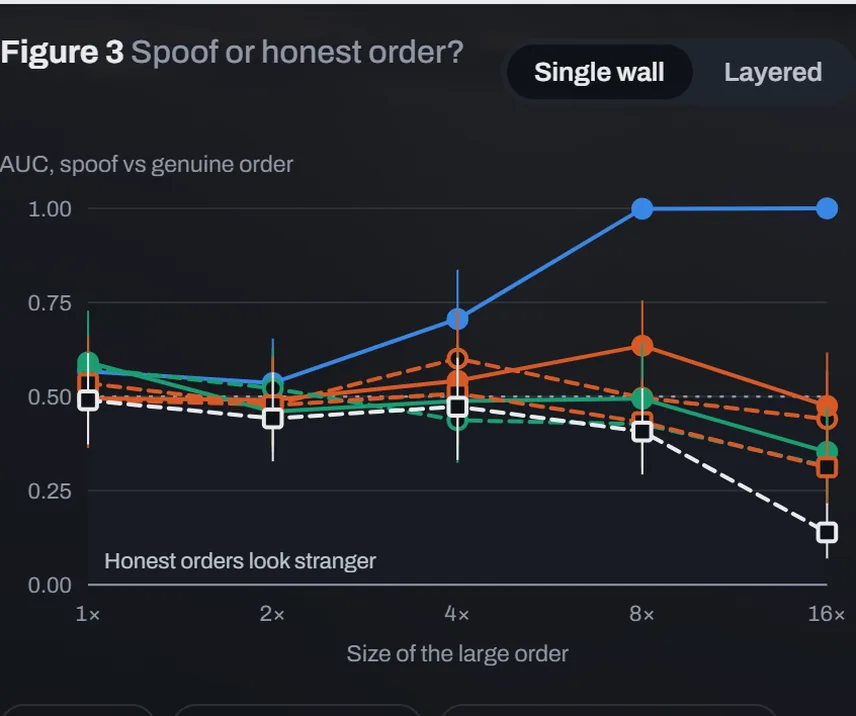
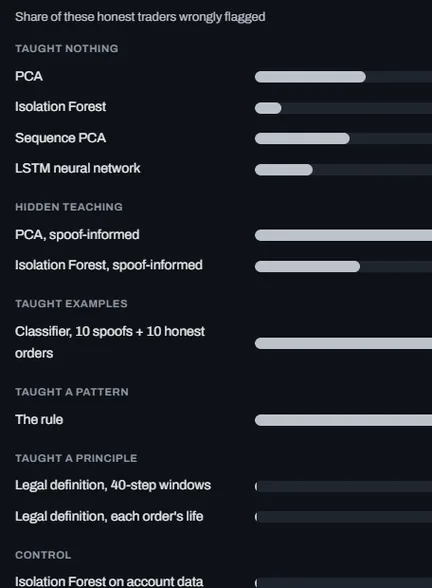
The starting hypothesis was that a label-free model would beat a hand-written rule. It is not supported, and the failure is robust: across five markets, two time resolutions, per-bar and sequence models, a neural network, and a detector that examined every single order. A spoof is only unusual in its size, and honest orders are big too.
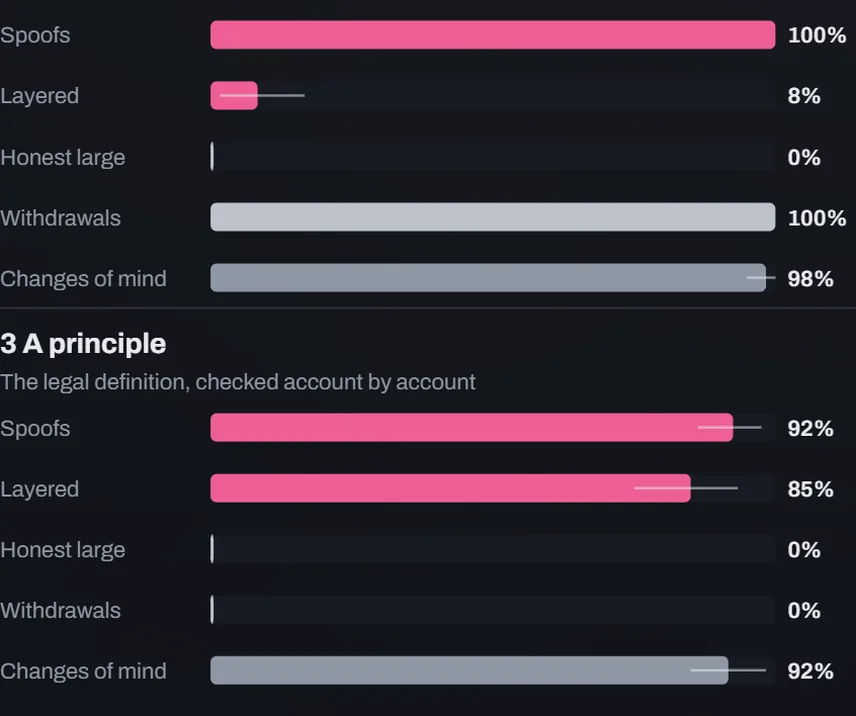
Part 2 shows what does work, and it is not more data or a bigger model. Examples and patterns teach a detector what spoofing looks like, and a spoofer who splits the wall into smaller orders no longer looks like that. The legal definition teaches what spoofing does: it shows interest that it withdraws, to help a trade on the other side. A detector built from that definition, with no examples and no training, caught single-wall and layered spoofs alike, flagged no honest large orders and no honest quick cancellations, and kept its false alarms low when the market changed. Given the same data without the definition, an untaught model caught none.
So the answer to the title question has two halves. Can AI detect manipulation without being taught what it looks like? Not by learning normal trading and flagging what is unusual. But it does not need to be shown what manipulation looks like either: told what it is, and shown who placed each order, it can. What no detector here could do is tell a spoof from an honest change of mind, because the actions are identical and only the intention differs. Detection can say that a signal was false; it takes an investigation to say why.
It has known weaknesses: a spoofer hidden in a busy broker account is harder to see, and one who uses two accounts can only be caught if the regulator knows who owns them. Part 3 tried the other obvious dodges: waiting before pulling the wall is caught once each order is judged over its own life, and buying back what was sold only escapes by giving up the gain. The next stage is real order data, where accounts are messier than in any simulation, and a spoofer who adapts to the detector.
Limitations
These results describe a simulation, not real markets. The market and the spoofer were both designed for this project, the traders are simplified, and there is no latency. The rule's success is partly circular, since it was written knowing the pattern, which is why the layered test exists. The principle detector was designed after Part 1, by someone who knew how the spoofer worked; it encodes the law rather than the spoofer's settings, and it was tested on layering, new markets and account structures it was not tuned for, but it is still one person's reading of the law. It also relies on account data that only regulators and exchanges hold, and the simulation's accounts are cleaner than real ones. Samples are around 80 spoof episodes per size, so intervals are wide at small sizes. An alert is never evidence of intent, only a reason to look closer. All spoofing in this project happens inside an offline simulation.
References
- Cao, Y., Li, Y., Coleman, S., Belatreche, A. & McGinnity, T. M. (2015). Adaptive hidden Markov model with anomaly states for price manipulation detection. IEEE Transactions on Neural Networks and Learning Systems, 26(2), 318-330.
- Commission Delegated Regulation (EU) 2017/580 (RTS 24) on the maintenance of relevant data relating to orders in financial instruments, as retained in UK law. legislation.gov.uk.
- Fabre, T. & Challet, D. (2025). Learning the spoofability of limit order books with interpretable probabilistic neural networks. arXiv:2504.15908.
- Financial Conduct Authority (2024). Market Abuse Surveillance TechSprint.
- Hochreiter, S. & Schmidhuber, J. (1997). Long short-term memory. Neural Computation, 9(8), 1735-1780.
- Leangarun, T., Tangamchit, P. & Thajchayapong, S. (2018). Stock price manipulation detection using generative adversarial networks. IEEE Symposium Series on Computational Intelligence.
- Liu, F. T., Ting, K. M. & Zhou, Z.-H. (2008). Isolation Forest. IEEE International Conference on Data Mining.
- Malhotra, P., Ramakrishnan, A., Anand, G., Vig, L., Agarwal, P. & Shroff, G. (2016). LSTM-based encoder-decoder for multi-sensor anomaly detection. arXiv:1607.00148.
- Regulation (EU) No 596/2014 on market abuse (Market Abuse Regulation), Article 12 and Annex I, as retained in UK law.
- Urra, Lopez Gonzalez & Sheth v Financial Conduct Authority (2025). Upper Tribunal (Tax and Chancery Chamber), decision of 1 July 2025.
- Wang, X. & Wellman, M. P. (2017). Spoofing the limit order book: an agent-based model. Proceedings of AAMAS 2017.
- Wang, X., Hoang, C., Vorobeychik, Y. & Wellman, M. P. (2021). Spoofing the limit order book: a strategic agent-based analysis. Games, 12(2), 46.