 Research LabPick a market situation and see how every detector reacts.
Part 2: what kind of teaching works?
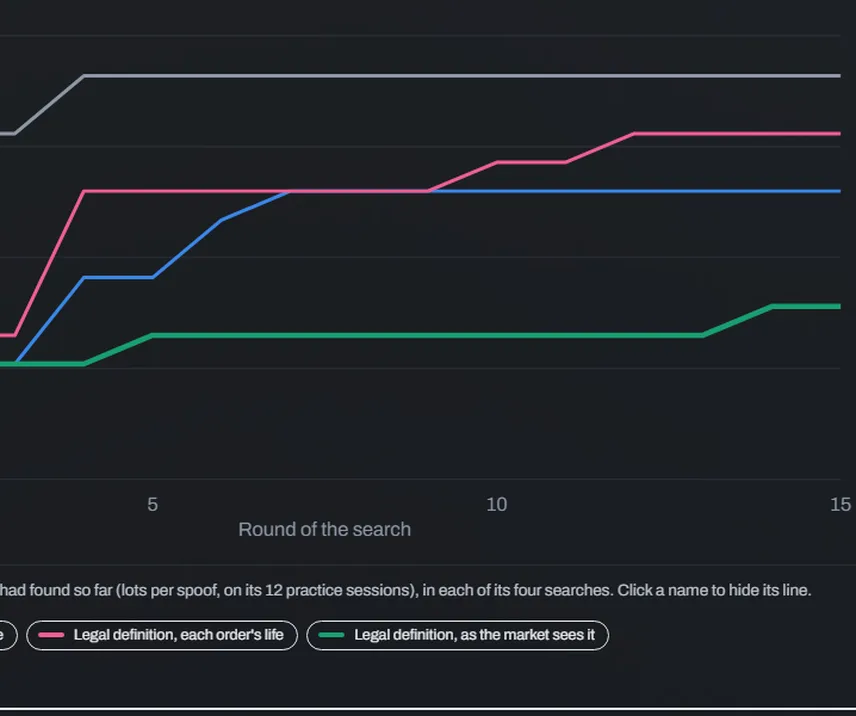
Part 1 found that learning what normal trading looks like is not enough. But the title's question has a second half: if a detector must be taught, what should it be taught? I gave detectors four levels of prior knowledge, a ladder, and tested every level on the same spoofs, the same honest orders, and one new case built to be as hard as possible.
- Nothing. Unusualness alone: the detectors of Part 1.
- Examples. A classifier shown labelled spoofs. In a fairer version it is also shown labelled honest large orders.
- A pattern. The surveillance rule: a large order cancelled quickly.
- A principle. The legal definition of the offence, and nothing else.
Turning the law into a detector
UK law does not define spoofing by what it looks like. The Market Abuse Regulation defines manipulation by its effect: orders that give, or are likely to give, false or misleading signals about supply or demand.9Market Abuse Regulation (EU) No 596/2014, Article 12(1)(a), retained in UK law. Its Annex I lists warning signs, including orders that are cancelled before they execute. That becomes three questions about one account over 40 steps. Did it show interest on one side? Was that interest withdrawn rather than traded? And did the same account trade the other way? If all three answers are yes, the score is the size of the false signal in lots. Nothing in it mentions size, timing, distance from the price or any example of spoofing, and nothing is learned: only its alert threshold is set on normal trading, at lots.
A market maker quotes the same amount on both sides, so it shows no direction at all, however often it cancels. That one word, direction, is why the busiest traders in the market score zero.
The principle needs one thing the earlier detectors never had: who placed each order. Regulators and exchanges have it, because trading venues must keep order records that identify the client.10Commission Delegated Regulation (EU) 2017/580 ("RTS 24") on keeping records of orders, retained in UK law. Anyone reading the public order book sees no names. So the fair comparison is an untaught Isolation Forest given exactly the same account-by-account data. If it did as well, the data would deserve the credit, not the principle.
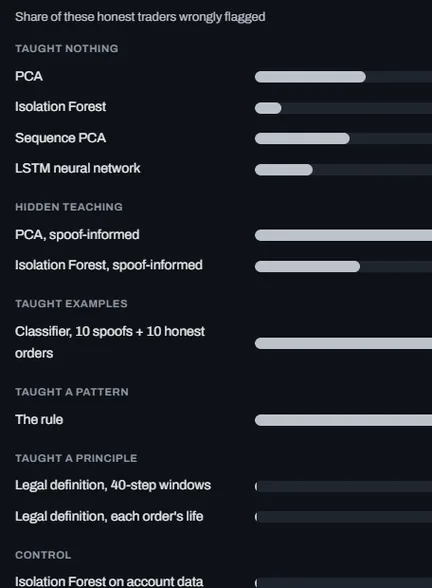
Figure 8 The ladder of teaching
Show the data for Figure 8
Examples and patterns teach the look
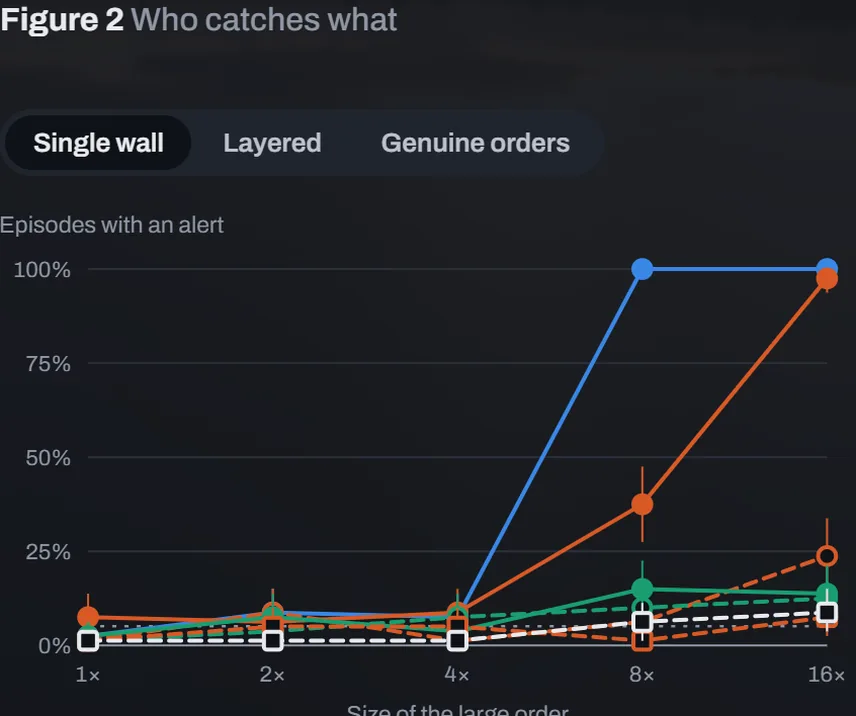
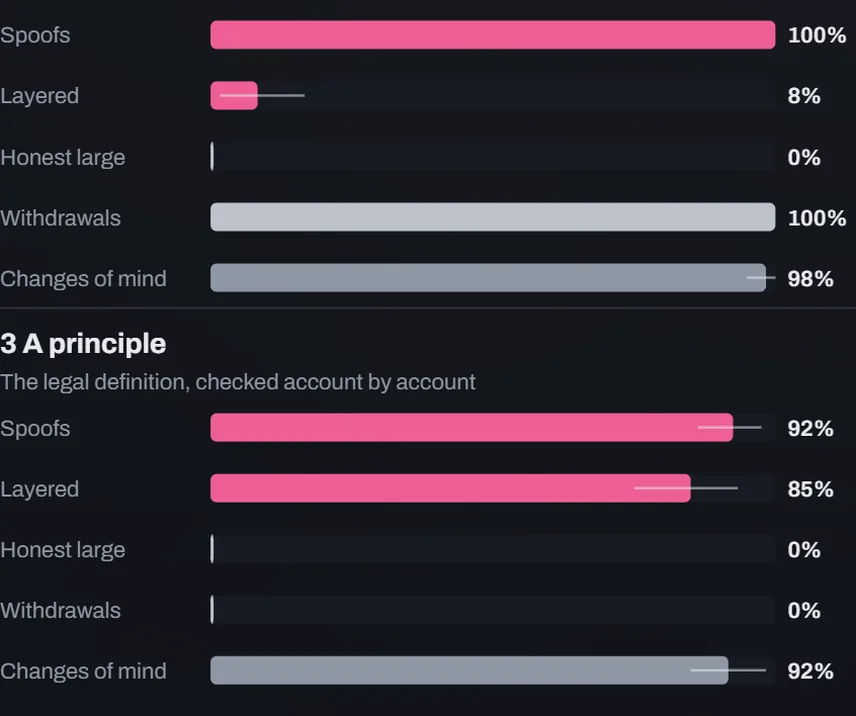
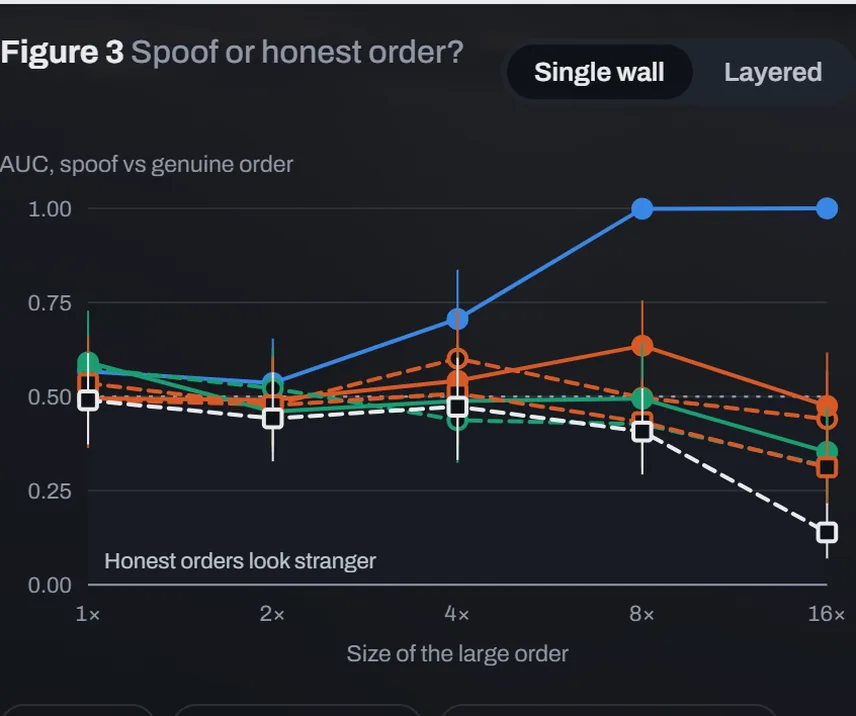
Shown only spoofs, the classifier learned "large order". It caught every wall, but it also flagged of honest large orders, and it caught of layered spoofs. Shown honest large orders as well, it learned "large and short-lived": it stopped flagging honest orders () but caught only of layered spoofs at 16× and at 8×, because a layered piece is smaller than anything it was shown. More examples did not change this. It is the rule's failure again: both learned what spoofs look like, so a spoof that looks different walks past. And both flagged honest traders who simply cancelled a large order quickly, without trading at all: the rule of them, the classifier . To a pattern, an honest quick cancellation and a spoof are the same thing.
A principle teaches the purpose
The principle caught of single-wall spoofs at 8× and at 16×, and and of layered ones: splitting a wall does not change what the trader showed, withdrew and traded. On the very same layered spoofs that is points over the rule at 16× (). Almost every spoof it missed never paid off, because its small order never traded; of the spoofs that worked it caught . It flagged of honest large orders and of honest quick withdrawals: cancelling quickly is not the offence, cancelling to help a trade on the other side is. When the market turned volatile its false alarms barely moved, from to of windows, where Part 1's learned detectors went from 1% to as much as half of all bars.
It is the principle, not the data. The untaught Isolation Forest on the same account data caught . It does rank spoofers as stranger than honest large traders (AUC ), but some honest trader is always stranger still, so a spoofer never reaches the top of its list (AUC against ordinary trading).
The case nothing can solve
An honest trader rests a large order. Then news changes their mind: they cancel it and trade a little the other way. Every action matches a spoof; only the reason differs. The principle flagged of these at 16× and could not tell them from spoofs at all (AUC ). The rule flagged . This is not a flaw to engineer away. Behaviour can show that a signal was false, but not why it was sent. That is why the law asks for intent to be proved, and why an alert should start an investigation, not end one.
Trying to break it
The principle was re-run in the four alternative markets from Part 1, with fewer or more traders sharing each account, with the spoofer hidden inside a broker's shared "omnibus" account, and with shorter and longer windows. Account numbers change nothing in the simulated trading itself, only the record of who did what.
How many traders share an account made no difference: from 10 to 800 accounts per trader type, the share of 8× spoofs caught stayed at . Windows from 40 to 160 steps changed little. The real weakness is the omnibus account. When the spoofer's orders went through a broker account that also carried 20% of everyone else's orders, other clients' trading diluted the signal, and the detector caught only of 8× spoofs and of 16× ones. Real surveillance has the same problem with orders that brokers group together for several clients.
A spoofer with two accounts
The obvious attack on a check of each account is to use two: show the wall from one and trade from the other. Then neither account breaks the definition on its own, and the detector caught of these spoofs. There are two repairs. If the regulator knows that both accounts belong to one person, merging them brings the catch rate back to at 16×. Without that link, the only option is to pair every account with every other, which throws away the third question. That caught , but it also flagged of honest traders who cancelled a large order quickly, and it needed a higher alert threshold ( lots, against ). The third question, whether the same person traded the other way, is what separates spoofing from an honest cancellation, and only knowing who owns which account lets a detector ask it.
Part 3: the price of evasion
A detector built from the law is only useful if a spoofer cannot simply step around it. So I gave the spoofer the obvious dodges and measured two things for each: how often it was still caught, and what the dodge cost it. The benefit is how many more lots the spoofer managed to trade the way it wanted than its honest twin, the same session with no wall.
Waiting before pulling the wall
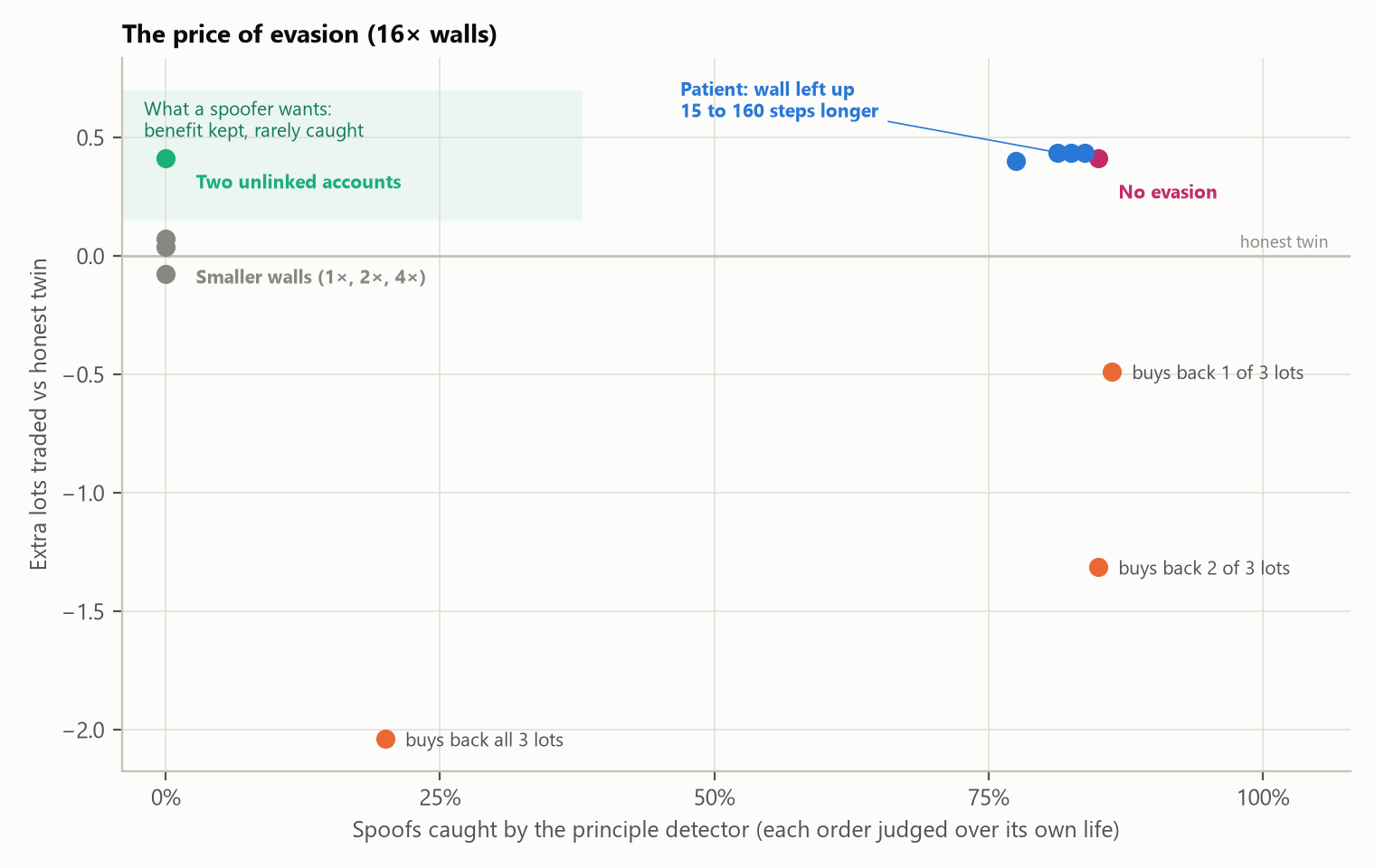
A patient spoofer leaves the wall up for a while after its real order trades, so that withdrawing it looks unconnected to the trade. Against the 40-step windows of Part 2 this worked, at almost no cost: leaving a 16× wall up 40 steps longer cut the catch rate from to . Longer windows help only until the spoofer waits longer still ( with 160-step windows against a 160-step wait). The fix is to drop windows altogether and judge every withdrawn order over its own life, from the step it was placed to the step it was withdrawn: the wall was alive while the real order traded, however long the wait. That version caught of the most patient spoofers. On honest trading it kept false alarms at of windows ( when volatile) and flagged of honest large orders and of honest quick withdrawals.
Buying back what was sold
A spoofer can also trade a little on the wall's own side, so that its account no longer traded only one way. Buying back one or two of its three lots made no difference: it was still caught ( and ). Buying back all three escaped most of the time ( caught), but only by undoing the very trade the spoof was for. It ended lots worse off than its honest twin and paid about ticks per lot to get there.
Figure 9 What each dodge keeps, and how often it is still caught
Show the data for Figure 9
Every dodge tried here either throws away what the spoof was for, or needs two accounts that the regulator cannot link. Smaller walls escape too, but below 8× a wall did not help the spoofer at all (Part 1). That leaves account ownership as the real battleground, which is where regulators already put their effort.